Indian Nobel Laureates: Complete List | PDF | Achievements (1913-2019)
The Nobel Prize represents one of the highest international honors in academia and humanitarian work. Since 1913, twelve individuals with Indian connections have received this recognition across various categories. This article provides a comprehensive overview of Indian Nobel laureates, their contributions, and the fields in which they worked.
Overview of Indian Nobel Laureates
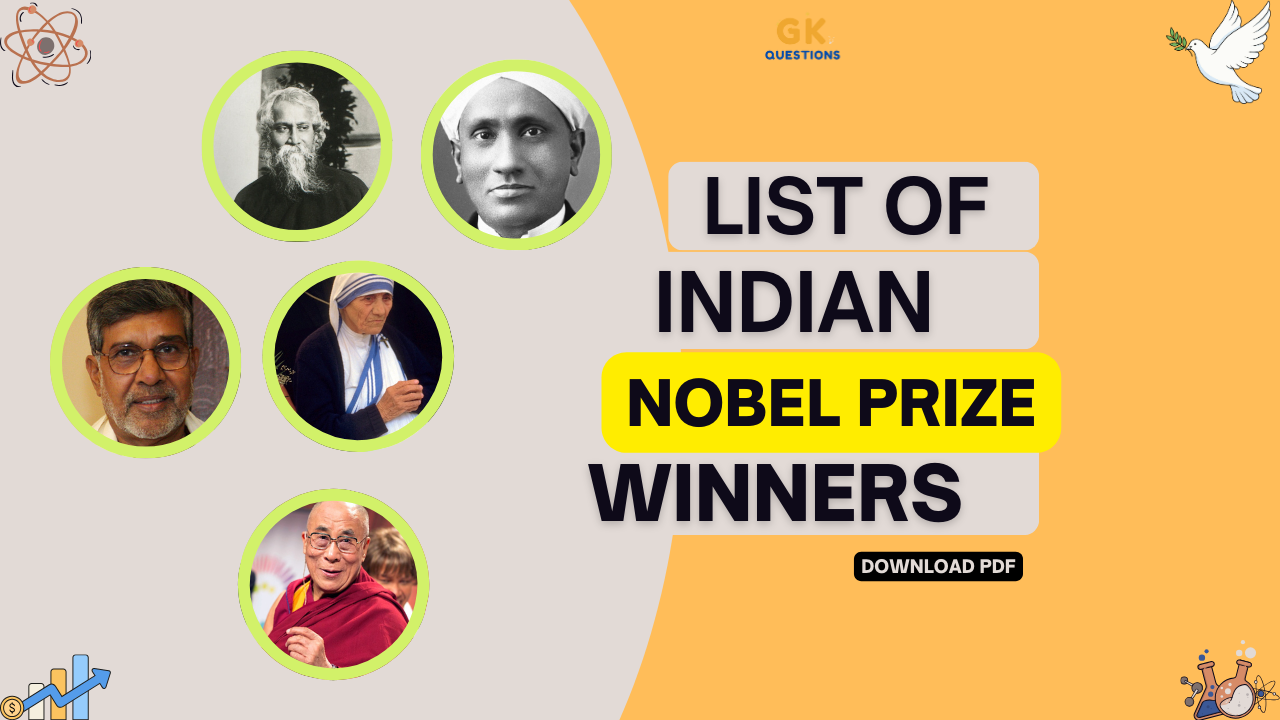
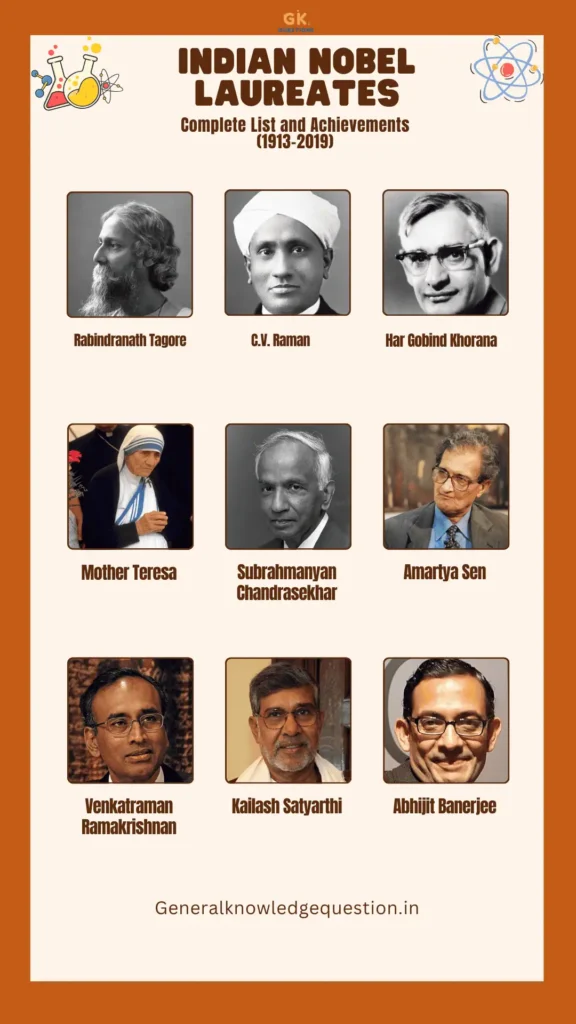
As of 2024, ten individuals associated with India have received Nobel Prizes. Among these, five hold Indian citizenship while five are of Indian origin or residency. The laureates span six categories: Literature, Physics, Chemistry, Physiology or Medicine, Peace, and Economic Sciences.
Complete List of Indian Nobel Laureates
| Year | Name | Category | Citizenship Status | Contribution |
| 1913 | Rabindranath Tagore | Literature | Indian | Poetry collection Gitanjali |
| 1930 | C.V. Raman | Physics | Indian | Discovery of Raman Effect (light scattering) |
| 1968 | Har Gobind Khorana | Physiology or Medicine | Indian-American | Interpretation of genetic code |
| 1979 | Mother Teresa | Peace | Indian (Albanian-born) | Humanitarian work with poor |
| 1983 | Subrahmanyan Chandrasekhar | Physics | Indian-American | Stellar structure and evolution theory |
| 1989 | Dalai Lama | Peace | Tibetan (resident in India) | Non-violent struggle for Tibet |
| 1998 | Amartya Sen | Economic Sciences | Indian | Welfare economics contributions |
| 2009 | Venkatraman Ramakrishnan | Chemistry | Indian-American-British | Ribosome structure studies |
| 2014 | Kailash Satyarthi | Peace | Indian | Fight against child labor |
| 2019 | Abhijit Banerjee | Economic Sciences | Indian-American | Experimental poverty alleviation approach |
Category-wise Distribution
| Category | Number of Laureates | Names |
|---|---|---|
| Physics | 2 | C.V. Raman, Subrahmanyan Chandrasekhar |
| Chemistry | 1 | Venkatraman Ramakrishnan |
| Physiology or Medicine | 1 | Har Gobind Khorana |
| Literature | 1 | Rabindranath Tagore |
| Peace | 3 | Mother Teresa, Dalai Lama, Kailash Satyarthi |
| Economic Sciences | 2 | Amartya Sen, Abhijit Banerjee |
Source: https://www.nobelprize.org/
Achievements of Indian Nobel Laureates
Rabindranath Tagore (1913)
Rabindranath Tagore became the first non-European Nobel laureate in Literature. Born in Kolkata in 1861, he received recognition for his poetry collection Gitanjali. The Nobel Committee cited his verse as profoundly sensitive, fresh, and beautiful. Tagore wrote in Bengali and translated his work into English. He composed Jana Gana Mana, which became India’s national anthem. In 1901, he established an experimental school at Santiniketan.
C.V. Raman (1930)
Chandrasekhara Venkata Raman received the Nobel Prize in Physics for his work on light scattering and the discovery of the Raman Effect. The Raman Effect describes how monochromatic light changes wavelength when passing through a transparent medium. This discovery occurred on February 28, 1928. Raman was the first Asian to win a Nobel Prize in Science. The phenomenon has applications in spectroscopy and molecular analysis.
Har Gobind Khorana (1968)
Har Gobind Khorana was born in Raipur, Punjab (now in Pakistan). He shared the Nobel Prize in Physiology or Medicine with Marshall W. Nirenberg and Robert W. Holley. The award recognized their interpretation of the genetic code and its function in protein synthesis. Khorana’s research involved constructing RNA chains using enzymes and synthesizing proteins. His work clarified how genetic information transfers from DNA to RNA to proteins.
Mother Teresa (1979)
Anjezë Gonxhe Bojaxhiu, known as Mother Teresa, was born in Skopje in 1910. She moved to India at age 18 and became an Indian citizen. She received the Nobel Peace Prize for her work with the poor in Calcutta. Mother Teresa founded the Missionaries of Charity, which operates in multiple countries. The organization provides care for people with terminal illnesses, operates orphanages, and runs facilities for those with disabilities.
Subrahmanyan Chandrasekhar (1983)
Subrahmanyan Chandrasekhar, received the Nobel Prize in Physics for his theoretical studies of stellar structure and evolution. Born in Lahore in 1910, he became an American citizen. His primary contribution is the Chandrasekhar Limit, which determines the maximum mass of white dwarf stars (approximately 1.4 solar masses). Stars exceeding this limit collapse into neutron stars or black holes.
Dalai Lama (1989)
The 14th Dalai Lama, born in Tibet in 1935, has lived in exile in Dharamshala, India, since 1959. He received the Nobel Peace Prize for his resistance to violence in the Tibetan liberation struggle. The Nobel Committee recognized his advocacy for peaceful solutions based on tolerance and mutual respect. He has promoted Buddhist teachings internationally and engaged in interfaith dialogue.
Amartya Sen (1998)
Amartya Sen was born in 1933. He received the Nobel Memorial Prize in Economic Sciences for his contributions to welfare economics. Sen’s research examined theories of famines, poverty measurement, and social choice theory. His work on the capabilities approach to development influenced policy frameworks. Sen has held academic positions at universities in India, the United Kingdom, and the United States.
Venkatraman Ramakrishnan (2009)
Venkatraman Ramakrishnan was born in Chidambaram, Tamil Nadu, in 1952. He shared the Nobel Prize in Chemistry with Thomas A. Steitz and Ada E. Yonath. The award recognized their studies on ribosome structure and function. Ramakrishnan used X-ray crystallography to map the ribosome at atomic resolution. His research revealed how ribosomes read genetic code and synthesize proteins.
Kailash Satyarthi (2014)
Kailash Satyarthi was born in Vidisha, Madhya Pradesh, in 1954. He shared the Nobel Peace Prize with Malala Yousafzai. The award recognized their efforts against child exploitation and for children’s right to education. Satyarthi founded the Bachpan Bachao Andolan (Save Childhood Movement) in 1980. The organization has rescued over 80,000 children from forced labor and trafficking.
Abhijit Banerjee (2019)
Abhijit Banerjee was born in Mumbai in 1961. He shared the Nobel Memorial Prize in Economic Sciences with Esther Duflo and Michael Kremer. The Royal Swedish Academy of Sciences recognized their experimental approach to alleviating global poverty. Banerjee co-founded the Abdul Latif Jameel Poverty Action Lab in 2003. The lab uses randomized controlled trials to test development interventions in poor communities.
Read More
- Complete Guide to Chief Justices of India GK Questions 2026
- Presidents of India Complete Guide | GK Questions | Free PDF 2026
- Indian National Symbols GK Questions for Competitive Exams 2026
- Indian Nobel Laureates: Complete List | PDF | Achievements (1913-2019)
- Rivers, Lakes and Dams of Madhya Pradesh: Complete Guide
Notable Nominations
Several individuals with Indian connections received Nobel Prize nominations but did not win. Mahatma Gandhi was nominated for the Nobel Peace Prize five times between 1937 and 1948. His final nomination came days before his assassination on January 30, 1948.
Sri Aurobindo received nominations for the Nobel Prize in Literature in 1943 and for the Nobel Peace Prize in 1950. Aurobindo was a poet, philosopher, and nationalist who established an ashram in Pondicherry.
Read about the First Indian Achievements Here
List of Indian Nobel Prize Winners PDF
Download our Indian Nobel Prize Winners list PDF for quick offline revisions.
Scientific Contributions Summary
The scientific contributions of Indian Nobel laureates cover multiple disciplines. In medicine, Har Gobind Khorana worked on molecular biology. In physics, C.V. Raman studied light behavior while Subrahmanyan Chandrasekhar examined stellar physics. Venkatraman Ramakrishnan’s chemistry work focused on cellular machinery.
These contributions have practical applications. The Raman Effect became a tool for molecular identification. Chandrasekhar’s stellar models inform astrophysics. Khorana’s genetic code research underpins biotechnology. Ramakrishnan’s ribosome studies aid drug development.
Humanitarian and Social Science Contributions
Three Indian Nobel laureates received Peace Prizes for different forms of humanitarian work. Mother Teresa focused on direct service to the poor and sick. The Dalai Lama promoted non-violent conflict resolution and religious tolerance. Kailash Satyarthi addressed child rights and education access.
The economic science laureates examined poverty and development from different angles. Amartya Sen developed theoretical frameworks for understanding famines and welfare. Abhijit Banerjee used field experiments to test poverty interventions. Both have influenced development policy
Institutional Affiliations
The laureates worked at various institutions globally. Academic institutions include University of Cambridge, University of Chicago, MIT, Harvard University, and several Indian universities. Research organizations include the Medical Research Council Laboratory of Molecular Biology and the Abdul Latif Jameel Poverty Action Lab.
Impact on Indian Science and Society
The recognition of Indian Nobel laureates has influenced research priorities and institutional development in India. C.V. Raman’s discovery led to establishment of research institutes focused on fundamental science. The Indian Institute of Science and Raman Research Institute continue his scientific legacy.
The humanitarian laureates have inspired social movements in India. Mother Teresa’s model of charitable service influenced healthcare delivery for underserved populations. Kailash Satyarthi’s child rights advocacy contributed to policy changes regarding child labor and education.
GK Questions on Indian Nobel Laureates
Question 1: Who was the first Indian Nobel laureate?
- A) C.V. Raman
- B) Rabindranath Tagore
- C) Ronald Ross
- D) Mother Teresa
Answer: B) Rabindranath Tagore was the first Indian citizen in 1913.
Question 2: How many Indian Nobel laureates have won in the field of Physics?
- A) 1
- B) 2
- C) 3
- D) 4
Answer: B) 2 (C.V. Raman and Subrahmanyan Chandrasekhar)
Question 3: What did C.V. Raman discover that earned him the Nobel Prize?
- A) The structure of DNA
- B) The Raman Effect (light scattering)
- C) Malaria transmission mechanism
- D) Black hole theory
Answer: B) The Raman Effect (light scattering)
Question 4: Which Indian Nobel laureate is related to C.V. Raman?
- A) Venkatraman Ramakrishnan
- B) Har Gobind Khorana
- C) Subrahmanyan Chandrasekhar
- D) Amartya Sen
Answer: C) Subrahmanyan Chandrasekhar (he was Raman’s nephew)
Question 5: How many times was Mahatma Gandhi nominated for the Nobel Peace Prize?
- A) 2
- B) 3
- C) 5
- D) 7
Answer: C) 5 times (between 1937 and 1948, but never won)
Question 6: Who is the only woman among Indian Nobel laureates?
- A) Indira Gandhi
- B) Mother Teresa
- C) Sarojini Naidu
- D) Kalpana Chawla
Answer: B) Mother Teresa
Question 7: What is the Chandrasekhar Limit?
- A) The speed of light in a vacuum
- B) The maximum temperature of a star
- C) The maximum mass of a white dwarf star (approximately 1.4 solar masses)
- D) The minimum distance between galaxies
Answer: C) The maximum mass of a white dwarf star (approximately 1.4 solar masses)
Question 8: Which Indian Nobel laureate shared the prize with Malala Yousafzai?
- A) Amartya Sen
- B) Kailash Satyarthi
- C) Abhijit Banerjee
- D) Dalai Lama
Answer: B) Kailash Satyarthi (2014 Nobel Peace Prize)
Question 9: Har Gobind Khorana won the Nobel Prize for work related to:
- A) Malaria research
- B) Genetic code and protein synthesis
- C) Economic welfare theories
- D) Stellar evolution
Answer: B) Genetic code and protein synthesis
Question 10: Who is the most recent Indian Nobel laureate as of 2024?
- A) Venkatraman Ramakrishnan
- B) Kailash Satyarthi
- C) Abhijit Banerjee
- D) Amartya Sen
Answer: C) Abhijit Banerjee (2019, Nobel Memorial Prize in Economic Sciences)
Conclusion
The ten Indian Nobel laureates represent contributions across science, literature, peace, and economics over more than a century. Their work ranges from fundamental research in physics and chemistry to applied work in medicine and poverty alleviation. The diversity of fields and citizenship statuses reflects India’s intellectual diaspora and domestic achievements.
The laureates’ geographic origins span the Indian subcontinent, with birth locations in present-day India, Pakistan, Bangladesh, Tibet, and Europe. Their educational backgrounds vary from traditional academic paths to self-directed learning. The institutional affiliations include both Indian and international organizations.
Recognition continues with the most recent award in 2019 to Abhijit Banerjee. The distribution across categories indicates strength in both sciences and humanitarian fields.